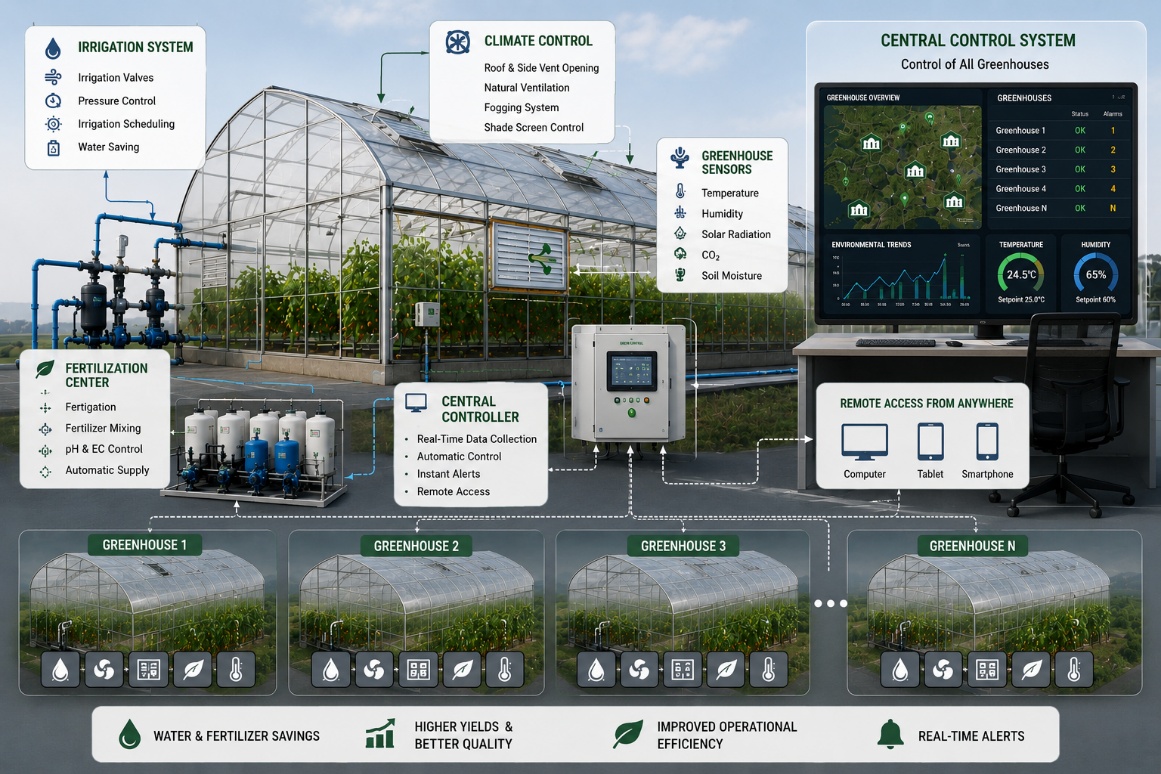
The evolution of modern agriculture is increasingly defined by the integration of advanced technologies that enable precise, efficient, and sustainable crop management. Among these, greenhouse cultivation stands out as a platform for implementing fully integrated automation systems, combining external meteorological monitoring, internal sensor networks, centralized control systems, and artificial intelligence (AI) to optimize plant growth conditions, reduce risks, and maximize yields over time.
Greenhouse cultivation has become a cornerstone of advanced agricultural production, offering the ability to control environmental conditions and mitigate the uncertainties associated with open-field farming. However, the true potential of greenhouse systems is realized when environmental control is integrated with real-time data acquisition and automated decision-making processes.
Integrated automation systems enable growers to move beyond reactive management toward a predictive, data-driven approach, where environmental conditions are continuously monitored, analyzed, and optimized.
External Environmental Monitoring
A key component of integrated greenhouse management is the installation of an advanced meteorological station outside the greenhouse. This system provides continuous, real-time data on:
- Temperature
- Relative humidity
- Wind speed and direction
- Rainfall
- Solar radiation
These parameters play a critical role in influencing greenhouse performance. By analyzing external conditions, the system can anticipate environmental stress factors such as heat waves, high radiation loads, or strong winds, allowing proactive adjustments within the greenhouse.
In addition, long-term data accumulation enables the development of a statistical climatic profile, supporting improved planning, risk assessment, and strategic decision-making.
Internal Climate Monitoring and Control
Within the greenhouse, a network of sensors continuously measures key microclimate variables, including temperature, humidity, and radiation. These data streams are processed by a centralized control system, which governs the operation of critical infrastructure:
- Ventilation systems (roof and side windows)
- Air circulation units
- Heating systems
- Misting and fogging systems
- Shading mechanisms
This integrated system ensures a dynamic equilibrium, where environmental conditions are constantly adjusted to maintain optimal parameters for plant growth.
Artificial Intelligence and Predictive Control
The integration of artificial intelligence represents a significant advancement in greenhouse automation. AI-driven systems analyze real-time and historical data to identify patterns and predict future conditions. Such systems are capable of:
- Detecting early signs of plant stress
- Identifying environmental conditions conducive to disease and fungal development
- Automatically activating corrective measures
By maintaining controlled fluctuations in humidity and temperature — particularly between day and night cycles — the system disrupts pathogen development and reduces the likelihood of disease outbreaks. This predictive approach minimizes crop losses and reduces dependency on chemical treatments.
Data Integration and Statistical Analysis
A fundamental advantage of integrated automation is the continuous accumulation of high-resolution data, including:
- External and internal environmental conditions
- System operational parameters
- Crop performance indicators (daily, monthly, annual yields)
The integration of these datasets enables correlation analysis between environmental variables and crop performance, identification of productivity trends, and data-driven optimization of growing strategies. Over time, the system evolves into a self-improving platform, leveraging machine learning and statistical analysis to enhance performance.
Yield Optimization and Operational Efficiency
The combination of real-time monitoring, automated control, and AI-driven analytics creates a comprehensive system designed to prevent plant stress, maintain optimal growth conditions, improve crop quality and uniformity, and maximize yield potential. This approach also contributes to improved resource efficiency, reduced operational costs, and enhanced sustainability.
Conclusion
Integrated automation in greenhouse agriculture represents a paradigm shift from traditional crop management to a precision-driven, data-centric model. By combining external environmental monitoring, internal climate control, artificial intelligence, and long-term data analysis, growers can achieve higher productivity, reduced risk, and more sustainable operations.