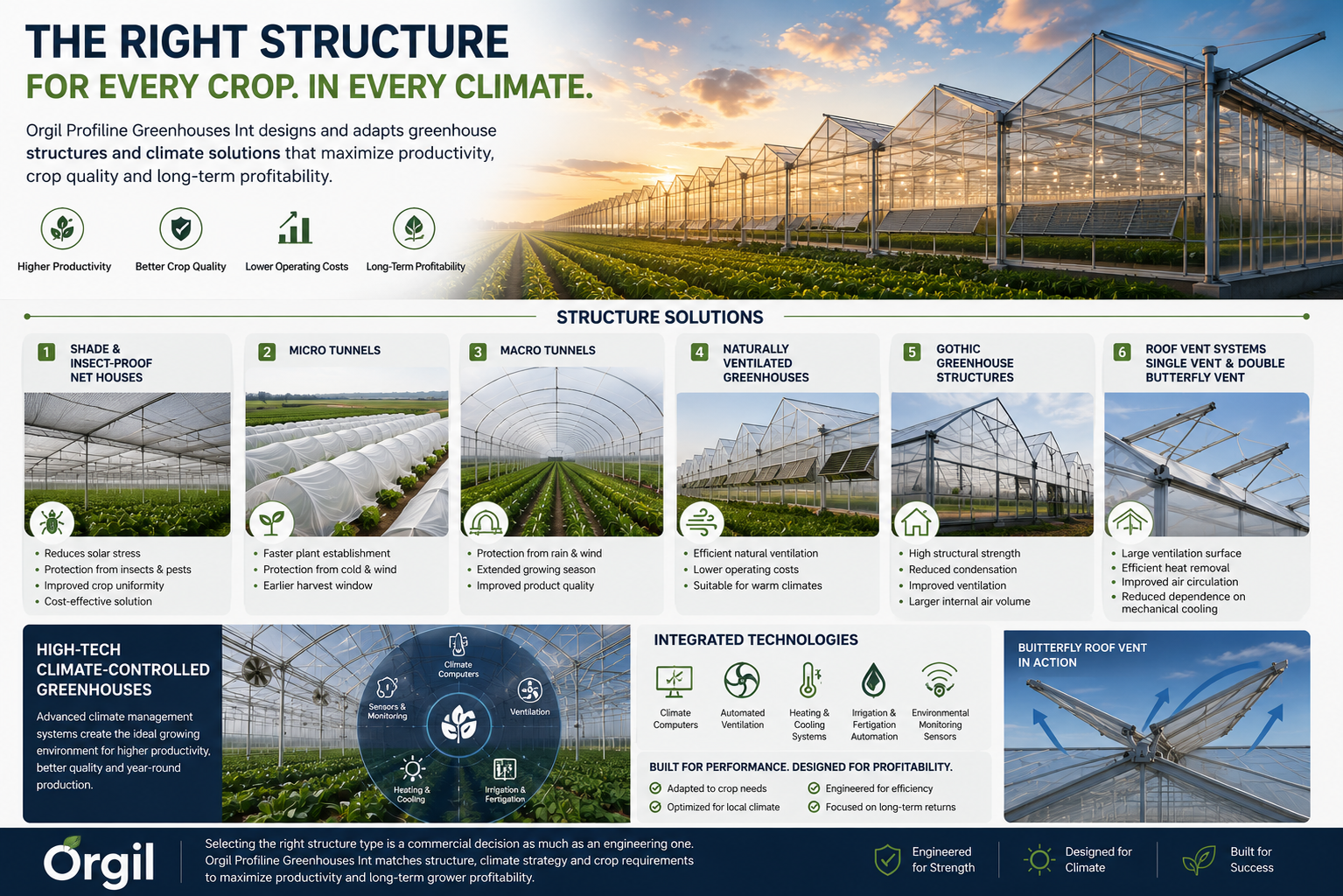
Orgil Profiline Greenhouses Int adapts greenhouse structures to the agronomic and economic suitability of each crop and local climate conditions. By combining climate control with commercial logic, the goal is to maximize grower productivity and long-term profitability.
1. Shade Houses / Insect-Proof Net Houses
Shade houses and insect-proof net houses are lightweight structures covered with specialized agricultural netting. They protect crops from excessive solar radiation while reducing the entry of insects that transmit viruses and diseases.
These systems are particularly valuable in warm climates where the main challenges are radiation intensity, pest pressure, and wind exposure. By reducing plant stress and insect pressure, they improve crop establishment and produce more uniform plant development.
Advantages:
- Reduced solar stress
- Protection from insects and pests
- Improved crop uniformity
- Cost-effective protected cultivation
2. Micro Tunnels
Micro tunnels are small plastic-covered structures placed directly over crop rows. They create a localized microclimate that protects young plants from wind, cold nights, and unstable early-season conditions.
By stabilizing the root-zone and canopy environment, micro tunnels accelerate plant establishment and may allow earlier harvests.
Advantages:
- Faster plant establishment
- Protection from cold and wind
- Earlier harvest window
3. Macro Tunnels
Macro tunnels are larger plastic-covered structures that allow growers to work inside the protected environment. They provide an intermediate level of protection between open-field cultivation and greenhouse production.
They are widely used for vegetables, berries, and specialty crops where rain protection, reduced wind damage, and improved crop quality are essential.
Advantages:
- Protection from rain and wind
- Extended growing season
- Improved product quality
4. Naturally Ventilated Greenhouses
Naturally ventilated greenhouses regulate internal climate through roof and side openings that allow airflow driven by natural pressure differences.
In hot climates, ventilation design is critical to remove excess heat and humidity. Orgil Profiline Greenhouses Int carefully designs vent size, position, and airflow paths to maintain climate stability.
Advantages:
- Efficient natural ventilation
- Lower operating costs
- Suitable for warm climates
5. Gothic Greenhouse Structures
The Gothic greenhouse is one of the most widely used greenhouse designs in modern agriculture. Its pointed roof improves water drainage, reduces condensation, and enhances airflow.
From an engineering perspective, Gothic structures provide a strong balance between structural strength, internal air volume, and climate performance.
Key Advantages:
- High structural strength
- Reduced condensation
- Improved ventilation efficiency
- Larger internal air volume
High-Tech Climate-Controlled Greenhouses
High-tech greenhouses integrate advanced climate management systems that automatically regulate environmental conditions throughout the production cycle.
These systems connect climate computers with sensors, motors, irrigation units, heating, cooling, and shading technologies to create precise and stable growing environments.
Integrated Technologies:
- Climate computers
- Automated ventilation systems
- Heating and cooling systems
- Irrigation and fertigation automation
- Environmental monitoring sensors
Through precise climate management, these systems enable higher productivity, improved crop quality, and year-round production.
6. Roof Vent Systems — Single Vent & Double Butterfly Vent
Roof ventilation systems — including single roof vents or double butterfly vents — are advanced ventilation configurations widely used in modern high-tech greenhouses.
The butterfly design opens roof panels along the ridge, increasing ventilation capacity and allowing warm air to escape efficiently. This design is particularly valuable in hot climates where passive cooling is essential.
Advantages:
- Large ventilation surface
- Efficient heat removal
- Improved air circulation
- Reduced dependence on mechanical cooling