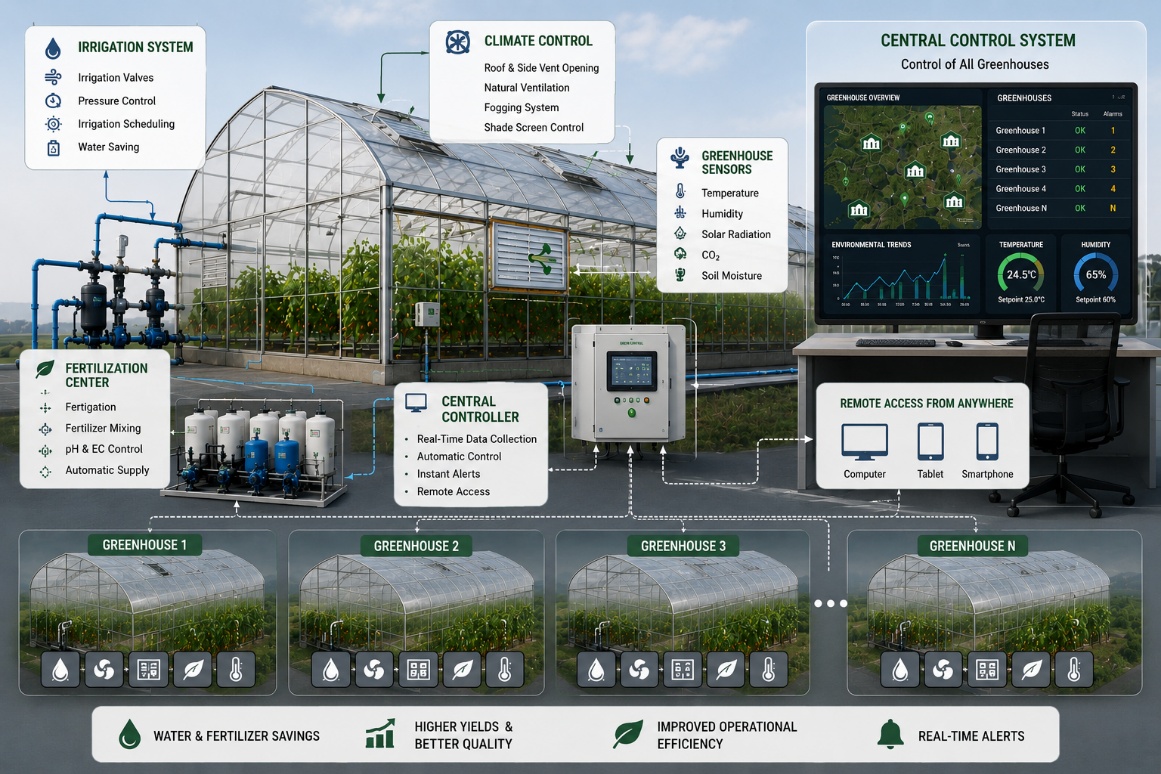
Modern greenhouse agriculture is increasingly driven by integrated automation systems that combine external climate monitoring, internal sensors, irrigation control systems, and artificial intelligence (AI) to optimize growing conditions and maximize yields.
External Meteorological Monitoring
An advanced meteorological station outside the greenhouse provides real-time data on temperature, humidity, wind, rainfall, and solar radiation. This enables early identification of environmental risks and supports long-term data analysis for improved decision-making.
Internal Climate Sensors & Control
Inside the greenhouse, sensors continuously measure temperature, humidity, and radiation. These data feed into a central control system that automatically operates ventilation, heating, fogging, and shading systems, ensuring optimal plant conditions at all times.
Irrigation & Fertigation Automation
An advanced irrigation computer controls fertigation and irrigation systems, precisely managing water and nutrient supply according to crop needs. The system operates in real time, continuously monitoring performance and providing immediate reporting, enabling full control and rapid response to any deviation.
AI-Driven Predictive Control
AI enhances this system by enabling predictive control. It identifies stress conditions and disease risks, and automatically adjusts climate parameters to prevent damage and reduce the need for chemical interventions.
Continuous Data & Long-Term Optimization
Continuous data collection — including environmental data, irrigation performance, and crop yield — allows statistical analysis and long-term optimization. Over time, the system learns and improves, increasing efficiency and productivity.
This integrated approach enables growers to reduce risk, improve crop quality, and maximize yields while operating more sustainably and efficiently.