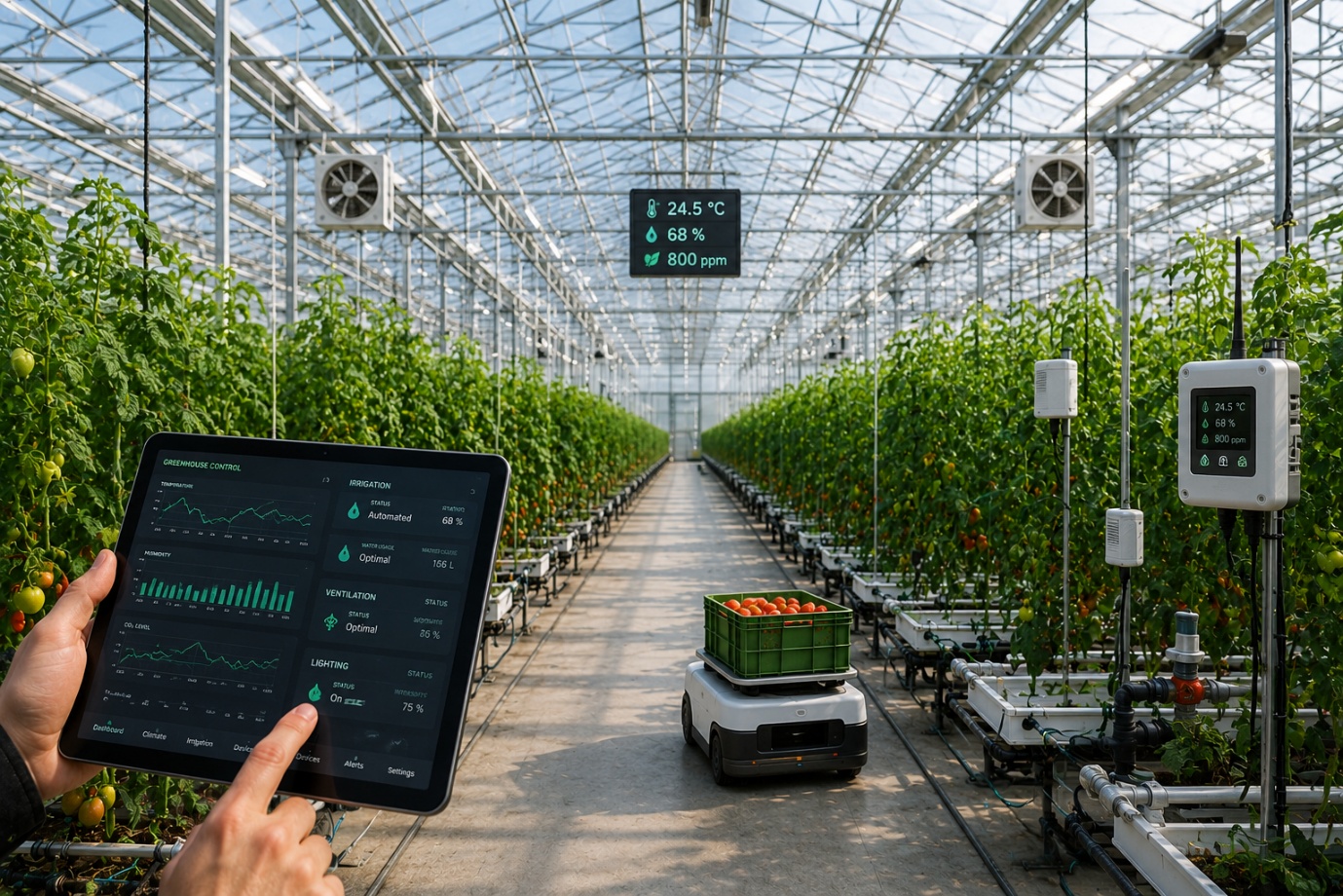
Modern greenhouse agriculture is based on the precise management of environmental conditions that influence plant physiology and crop productivity. Through integrated climate technologies — combining ventilation, shading, heating, cooling, humidity control, and CO₂ enrichment — greenhouse environments can be transformed into stable and highly efficient production systems.
At Orgil Profiline Greenhouses Int, climate engineering is designed as an integrated production strategy that supports reliable fruit set, consistent crop development, and long-term agricultural profitability.
A greenhouse is no longer only a structure that protects plants from external weather conditions; it is an engineered production environment where temperature, humidity, radiation, airflow, and carbon dioxide levels must be carefully managed. Even small fluctuations in temperature or humidity can influence plant growth, flowering, pollination, and fruit development.
Key Climate Factors in Greenhouse Production
Successful greenhouse cultivation depends on balancing several environmental factors that directly influence plant physiology and crop productivity:
☀️ Light (Solar Radiation)
The primary energy source for photosynthesis. Managing radiation levels through coverings, shading systems, and climate screens ensures optimal light without heat stress.
🌡️ Temperature
Regulates plant metabolism, growth rate, flowering, and fruit development. Stability is especially critical during flowering and fruit set.
💧 Humidity
Affects plant transpiration, nutrient uptake, and disease development. Balanced humidity helps maintain plant health and reduce disease pressure.
🌬️ Air Movement
Distributes heat, humidity, and CO₂ throughout the greenhouse. Proper airflow prevents localized microclimates and supports uniform plant development.
🌿 Carbon Dioxide (CO₂)
A fundamental component of photosynthesis. Controlled enrichment allows plants to use available light more efficiently and supports increased productivity.
💦 Water & Nutrients
Precise irrigation and fertigation deliver water and nutrients directly to the root zone, maintaining optimal plant balance and supporting uniform growth.
Natural Ventilation — Passive Climate Control
Natural ventilation is one of the most fundamental principles in greenhouse climate engineering, particularly in warm climates. Roof vents and side openings allow warm air to escape from the greenhouse while cooler outside air enters the structure. This natural airflow removes excess heat and humidity without requiring mechanical energy.
When properly engineered, natural ventilation stabilizes the greenhouse climate, improves plant transpiration, and reduces humidity levels that could otherwise increase disease pressure.
Shading Systems — Managing Solar Radiation
In regions with strong solar radiation, controlling light intensity becomes essential to prevent plant stress. Shading systems reduce excessive solar radiation entering the greenhouse while maintaining sufficient light for photosynthesis. By moderating incoming radiation, shading systems help maintain optimal leaf temperature and prevent plant overheating.
Movable shading systems allow growers to dynamically adjust shading levels according to daily radiation conditions, providing precise control throughout the growing cycle.
Climate Screens — Energy Efficiency & Temperature Stability
Climate screens are movable internal screens installed inside the greenhouse structure. During nighttime hours, thermal screens reduce heat loss from the greenhouse, improving energy efficiency. During daytime hours, reflective or diffusive screens help regulate solar radiation and reduce excessive heat accumulation.
- Improved temperature stability across the production area
- Reduced heating energy consumption in cold periods
- Lower condensation levels reducing disease risk
- More uniform greenhouse climate for consistent crop development
Air Circulation Systems — Uniform Climate Distribution
Air circulation fans maintain continuous airflow throughout the greenhouse, distributing heat, humidity, and CO₂ evenly across the crop area. Uniform airflow helps prevent humidity pockets within dense plant canopies, reduces disease risks, and supports stable plant development throughout the entire growing area.
Heating Systems — Temperature Stability During Critical Crop Stages
Heating systems maintain stable greenhouse temperatures during cold nights or seasonal transitions. Temperature stability is especially important during flowering and fruit set, when sudden temperature drops may negatively affect pollination and crop development.
Hot-water heating systems circulate warm water through pipes installed along greenhouse rows, providing uniform radiant heat and high energy efficiency in large installations.
Forced-air heating systems distribute warm air through heaters and fans, allowing rapid temperature adjustment during sudden cold conditions. In regions exposed to snowfall, controlled heating combined with air circulation can also help reduce snow accumulation on the greenhouse roof.
Both systems are integrated with climate computers for precise temperature control and efficient energy management.
Fogging Systems — Humidity Control & Gentle Cooling
Fogging systems generate extremely fine water droplets that evaporate rapidly in the greenhouse air. This evaporation increases humidity while slightly lowering air temperature. Fogging systems are particularly useful in dry climates where crops may experience excessive transpiration stress, providing cooling without wetting the plants directly.
Pad & Fan Evaporative Cooling — Efficient Cooling for Hot Climates
Pad-and-fan cooling systems are widely used in greenhouses located in hot and dry climates. Ventilation fans draw outside air through wet cooling pads installed along the greenhouse wall. As the air passes through the pads, evaporation reduces the air temperature before it enters the greenhouse.
This system significantly reduces incoming air temperature and is considered one of the most effective cooling solutions for hot-climate greenhouse production, delivering substantial temperature reductions with relatively low energy consumption.
CO₂ Enrichment — Enhancing Photosynthesis & Crop Productivity
Carbon dioxide plays a central role in plant photosynthesis. In many greenhouse environments, natural atmospheric CO₂ levels are lower than the optimal concentration required for maximum plant productivity. By supplying additional CO₂ inside the greenhouse, plants can convert light energy into plant biomass more efficiently.
- Improved photosynthesis efficiency and higher yield potential
- Stronger plant growth and improved fruit size
- Better crop uniformity across the growing area
- Most effective when ventilation openings are relatively limited and sufficient light is available
Structural Design for Environmental Loads
Greenhouse structures must be designed to withstand a range of environmental loads while maintaining optimal production conditions. Three main structural loads are considered in greenhouse engineering:
- Wind Load: Wind pressure and uplift forces influence greenhouse stability. Structural frame strength, anchoring systems, and aerodynamic roof geometry help ensure stability during high winds.
- Snow Load: In regions where snowfall may occur, greenhouse structures must be designed to support potential snow accumulation. Structural geometry and roof slope help distribute loads safely, while heating systems may assist in reducing snow buildup.
- Equipment & Crop Load: Modern greenhouse production includes additional loads such as irrigation systems, climate screens, crop support structures, and technical equipment. Structural design must account for these loads to ensure long-term safety and operational reliability.
Integrated Climate Strategy
Every greenhouse project presents unique climate challenges depending on geographic location, radiation levels, humidity conditions, crop type, and economic considerations. For this reason, climate technologies should never be implemented as independent components.
Instead, ventilation, shading, cooling, heating, humidity control, and CO₂ management must operate as a coordinated environmental system. At Orgil Profiline Greenhouses Int, greenhouse climate technologies are engineered as integrated solutions designed to create stable growing environments and reliable crop performance.
Through this integrated climate strategy, growers can achieve improved fruit set, higher crop quality, efficient resource utilization, and long-term agricultural productivity.