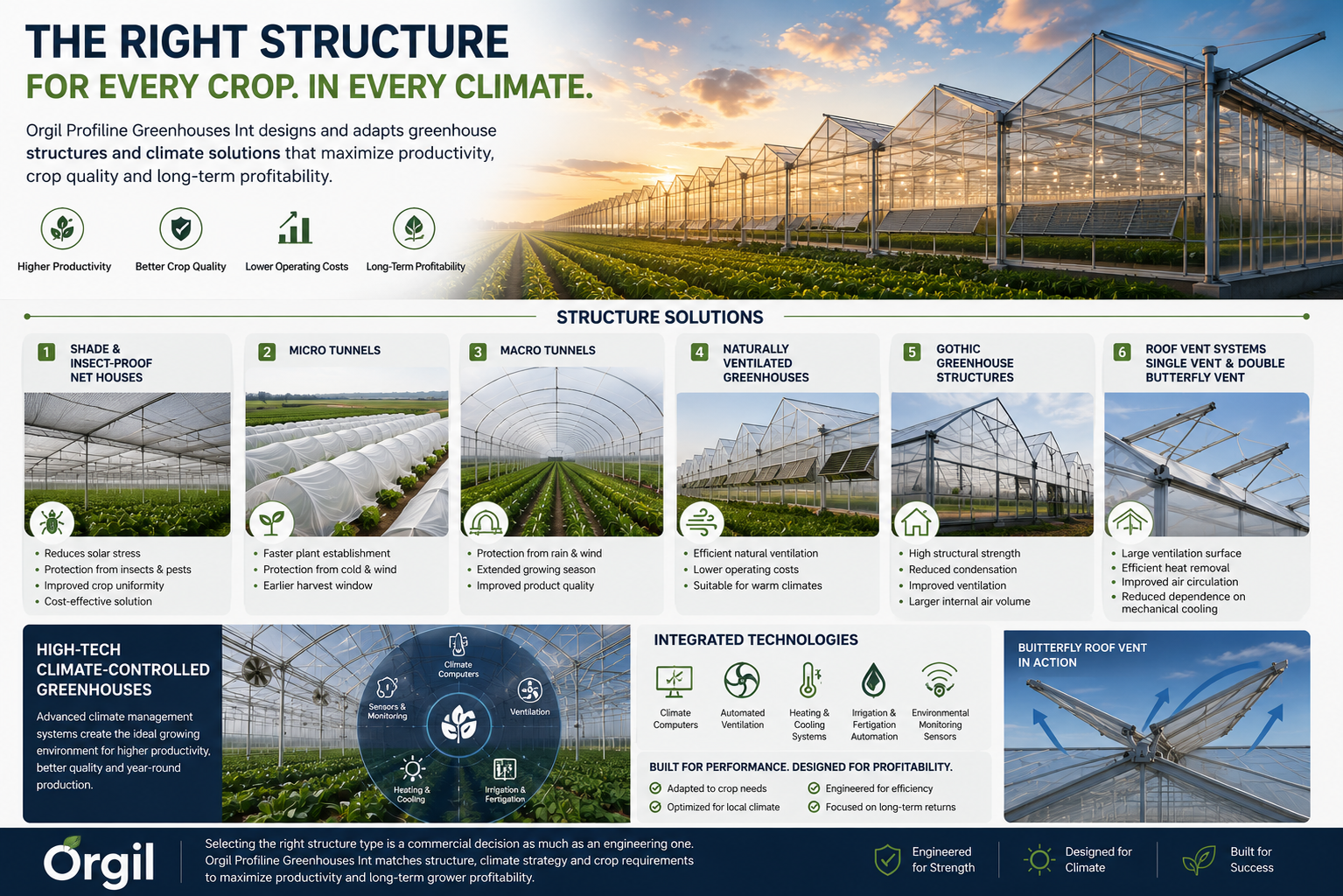
Modern protected agriculture requires greenhouse structures that are carefully adapted to local climate conditions, crop requirements, and economic considerations. Different crops respond differently to temperature, radiation levels, humidity, and airflow. For this reason, selecting the appropriate structure is a critical step in designing a successful greenhouse project.
Orgil Profiline Greenhouses Int develops greenhouse solutions based on a tailored engineering approach that integrates agronomic performance with commercial viability. By combining structural design with climate strategy, irrigation systems, and crop requirements, Orgil creates greenhouse environments that maximize productivity, crop quality, and long-term grower profitability.
Shade Houses and Insect-Proof Net Houses
Shade houses and insect-proof net houses are lightweight structures covered with specialized agricultural netting designed to protect crops from excessive solar radiation while reducing the entry of insects that may transmit plant viruses and diseases.
These structures are particularly valuable in warm climates where the main challenges are high radiation levels, pest pressure, and wind exposure rather than low temperatures. By reducing plant stress and minimizing insect pressure, shade houses can significantly improve crop establishment and overall crop uniformity.
In professional greenhouse design, net structures are not merely protective covers but microclimate management systems. Net density, shading percentage, airflow characteristics, and orientation all influence internal temperature, humidity, and pest control performance.
Advantages:
- Reduced solar stress
- Protection against insects and pests
- Improved crop uniformity
- Cost-effective transition to protected agriculture
Micro Tunnels
Micro tunnels are small plastic-covered structures installed directly over crop rows. They create a localized microclimate that protects young plants during the early stages of development.
Their main role is to shield seedlings from wind, cold nights, and unstable early-season weather conditions. By stabilizing the root-zone and canopy environment, micro tunnels accelerate plant establishment and promote early crop vigor.
Advantages:
- Faster plant establishment
- Protection from cold and wind
- Earlier harvest window
In many crops, early harvest timing has strong economic value. Even a modest advancement of the harvest period can significantly improve market prices and profitability.
Macro Tunnels
Macro tunnels are larger plastic-covered structures that allow growers to work inside the protected environment. They provide an intermediate level of protection between open-field cultivation and fully controlled greenhouse systems.
These structures are widely used for vegetables, berries, and specialty crops where protection from rain, wind, and unstable weather conditions improves product quality and marketable yield.
Advantages:
- Protection from rain and wind
- Extended growing season
- Improved product quality
For many growers, macro tunnels represent a practical step toward more advanced greenhouse production systems.
Naturally Ventilated Greenhouses
Naturally ventilated greenhouses regulate the internal environment through roof and side openings that allow airflow driven by natural pressure differences.
In warm climates, effective ventilation design is one of the most important factors in greenhouse engineering. Excess heat and humidity can quickly reduce crop performance, increase disease pressure, and damage fruit quality.
Orgil Profiline Greenhouses Int carefully designs ventilation openings, airflow paths, and structural geometry in order to optimize natural climate regulation.
Advantages:
- Efficient natural ventilation
- Lower operational energy costs
- Suitable for warm and high-radiation climates
Proper ventilation design reduces reliance on mechanical cooling systems while improving plant health and greenhouse climate stability.
Gothic Greenhouse Structures
The Gothic greenhouse is one of the most widely used greenhouse structures in modern protected agriculture. Its distinctive pointed roof shape improves rainwater drainage, reduces condensation formation, and enhances internal airflow.
From an engineering perspective, Gothic structures provide an optimal balance between structural strength, internal air volume, and climate performance.
Key Advantages:
- High structural strength
- Reduced condensation buildup
- Improved ventilation efficiency
- Larger internal air volume
A larger air volume inside the greenhouse helps stabilize temperature and humidity fluctuations, creating a more stable growing environment for sensitive crops such as tomatoes, cucumbers, and peppers.
High-Tech Climate-Controlled Greenhouses
Advanced greenhouse production systems integrate sophisticated climate control technologies that automatically regulate environmental conditions throughout the production cycle.
In high-tech greenhouse environments developed by Orgil Profiline Greenhouses Int, climate management is coordinated by climate computers connected to sensors, motors, irrigation systems, shading screens, heating systems, and cooling equipment.
These integrated systems allow growers to maintain optimal growing conditions with high precision and reliability.
Integrated Technologies:
- Climate computers and environmental sensors
- Automated ventilation systems
- Heating and cooling technologies
- Irrigation and fertigation automation
- Continuous climate monitoring systems
Through precise climate control, growers can achieve higher productivity, improved crop quality, and consistent year-round production.
Advanced Roof Ventilation Systems — Single Roof Vent & Double Butterfly Vent
Roof ventilation systems are among the most important components of greenhouse climate management.
Modern greenhouse designs often incorporate single roof vents or double butterfly roof vents that open along the ridge of the greenhouse structure. In the butterfly configuration, roof panels open on both sides, creating large ventilation openings that allow warm air to escape efficiently.
This design is particularly valuable in hot climates and high-radiation regions, where passive cooling plays a critical role in maintaining stable greenhouse temperatures.
Advantages:
- Large ventilation surface area
- Efficient heat extraction from the greenhouse
- Improved air circulation
- Reduced dependence on mechanical cooling systems
By optimizing roof ventilation geometry, Orgil Profiline Greenhouses Int enhances natural airflow and improves climate stability, helping growers maintain productive greenhouse environments even under challenging climate conditions.
Integrated Engineering Approach
The success of modern greenhouse production depends on the integration of multiple systems: structure design, climate control technologies, irrigation management, crop strategy, and operational planning.
Orgil Profiline Greenhouses Int approaches greenhouse development as a fully integrated engineering process, ensuring that every structural solution supports both agronomic performance and economic sustainability.