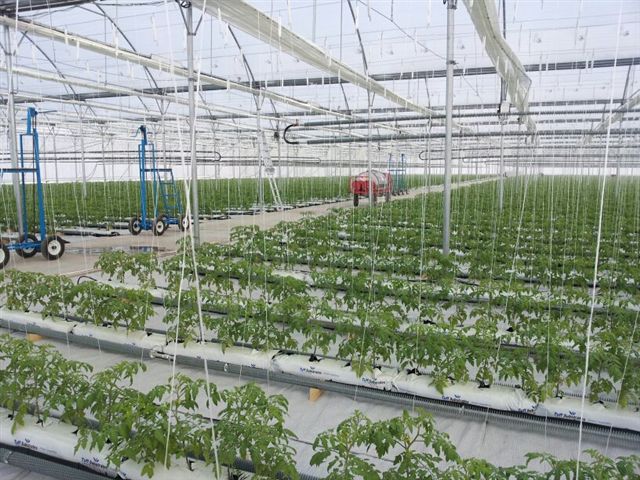
In modern greenhouse agriculture, water and nutrient management are among the most critical factors determining plant health, fruit set, and final yield. Even small imbalances in irrigation or nutrient supply can affect plant development, crop uniformity, and productivity across an entire production cycle.
Advanced greenhouse systems therefore rely on precision irrigation and fertigation technologies that deliver the exact amount of water and nutrients required by the crop at every stage of development. Proper water management improves root activity, maintains plant balance, and supports consistent fruit formation from flowering through to harvest.
Orgil Profiline Greenhouses Int integrates irrigation, fertigation, and climate control technologies into a coordinated production strategy designed to maximize water efficiency, crop uniformity, and yield per square meter. Selecting the right cultivation method is one of the earliest and most consequential decisions in any greenhouse project, since it shapes capital cost, operating cost, water use, and achievable yield for the life of the installation.
Soil Cultivation
In soil cultivation, plants grow directly in greenhouse soil, using irrigation systems to deliver water and nutrients. It remains the most familiar and lowest-cost entry point into protected agriculture, and for many growers transitioning from open-field production, it offers a natural first step.
Advantages:
- Lower initial installation cost
- Familiar cultivation practices for many growers
Limitations:
- Limited control over nutrient balance
- Higher risk of soil-borne diseases
- Lower crop uniformity compared to controlled systems
Because nutrient and moisture levels in soil are harder to standardize across a growing area, soil cultivation typically requires more conservative irrigation scheduling and closer field monitoring to maintain consistent plant performance.
Soilless Substrate Cultivation
Plants grow in inert substrates such as coco peat, perlite, or rockwool, while irrigation systems supply precisely balanced nutrient solutions directly to the root zone. This decouples plant nutrition from the variability of native soil, giving growers a controlled and repeatable rooting environment.
Advantages:
- Accurate water and nutrient control
- Reduced soil disease risks
- Improved crop uniformity
- Higher production potential
Substrate systems allow growers to control the root-zone environment more precisely than traditional soil cultivation, and they make it far easier to standardize irrigation and fertigation programs across large greenhouse areas — an important factor when consistency of supply and quality matters to buyers.
Hydroponic Cultivation
Hydroponic cultivation delivers nutrients directly through carefully balanced nutrient solutions, often with minimal or no solid substrate. It represents the most technically advanced end of the cultivation spectrum, and is typically paired with the tightest climate and irrigation control.
Advantages:
- Precision nutrient delivery
- Extremely high water efficiency
- Maximum yield potential
- Consistent crop quality
Hydroponic systems are widely used in high-tech greenhouse production, where precise climate and irrigation control allow growers to achieve high productivity and year-round supply. Because water and nutrients are recirculated within a closed system, hydroponic production also delivers among the highest water-use efficiency of the four methods — a significant advantage in water-scarce regions.
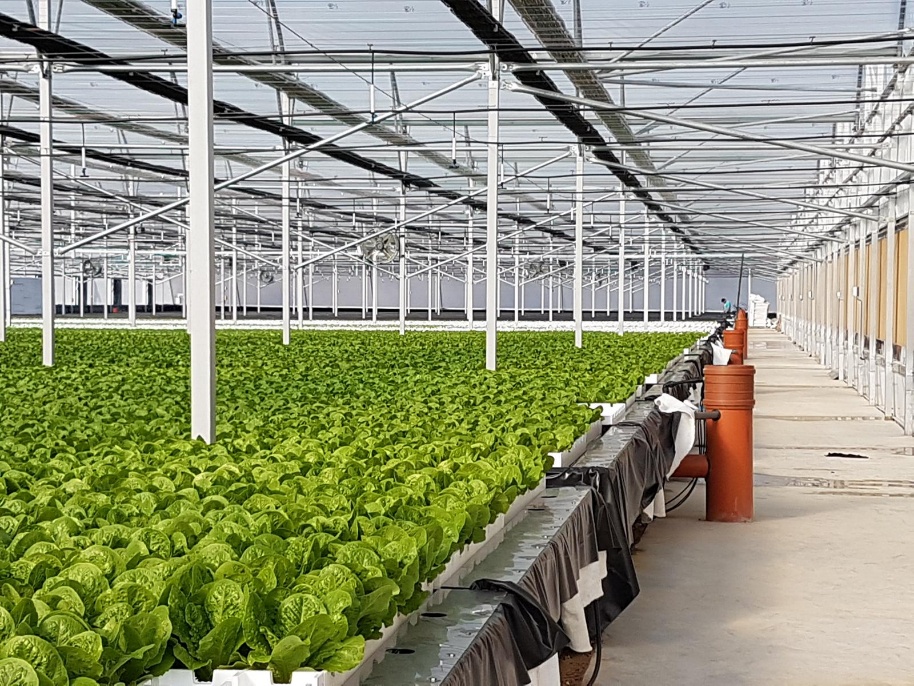
Floating Growing Beds (Raft Systems)
Floating growing beds are hydroponic cultivation systems primarily designed for leafy vegetables such as lettuce, herbs, spinach, and other leafy crops. Plants are supported on floating rafts above shallow nutrient solution reservoirs, allowing the roots to receive a continuous supply of water, oxygen, and balanced nutrients. This cultivation method provides highly uniform growing conditions, rapid crop development, and excellent water-use efficiency.
Advantages:
- Excellent water-use efficiency
- Rapid and uniform crop growth
- Consistent crop quality
- Ideal for commercial leafy vegetable production
Matching Method to Project Goals
No single cultivation method is universally correct. The right choice depends on crop type, local climate, available capital, water availability, and the target market for the produce. A leafy-green operation supplying a local retail market has different priorities than a export-oriented tomato or pepper operation competing on year-round consistency.
By combining precision irrigation, advanced fertigation control, and integrated climate management, Orgil Profiline Greenhouses Int helps growers select the most suitable cultivation strategy based on crop type, local climate conditions, and project goals.