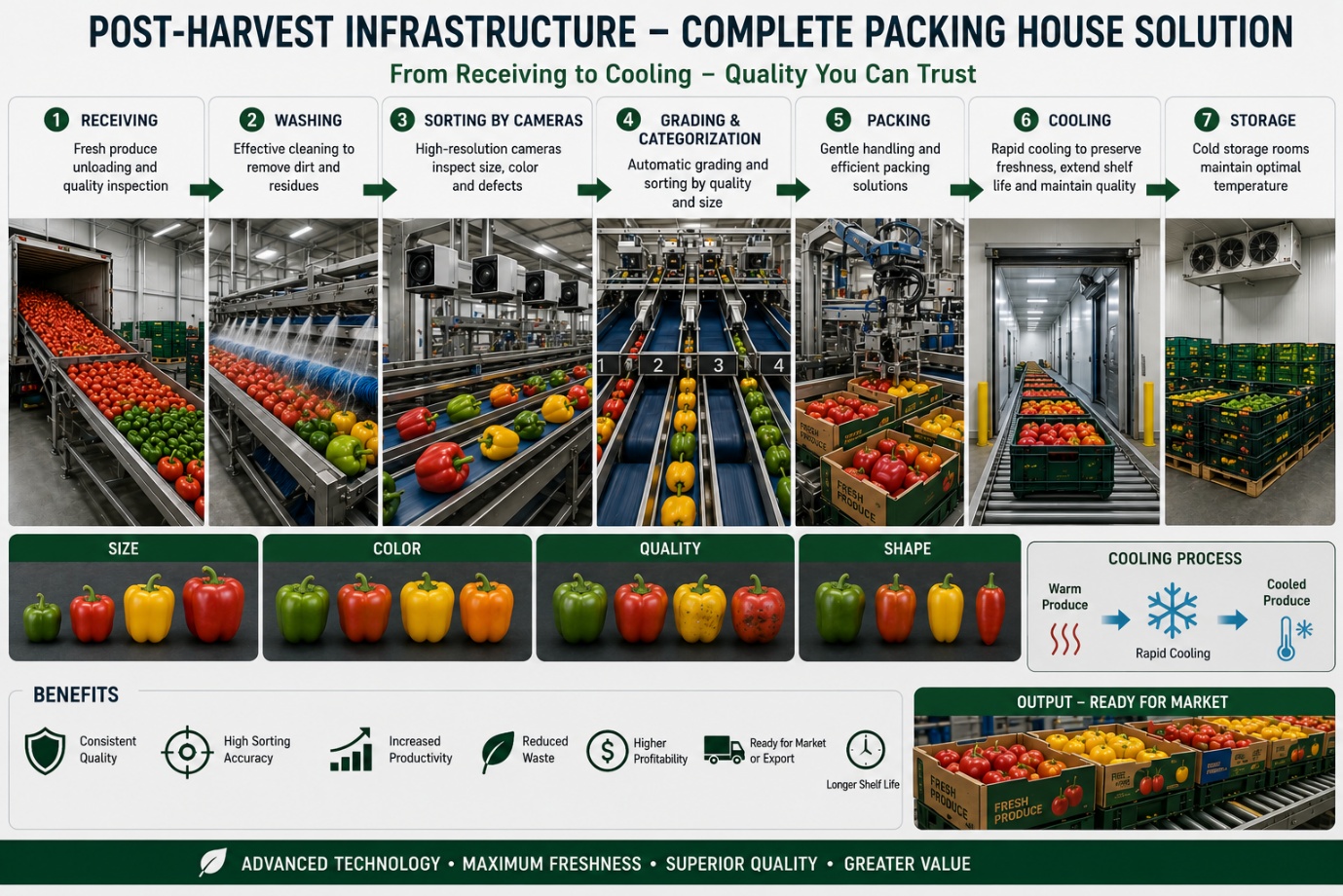
In modern greenhouse agriculture, producing high-quality crops is only the first step. A significant portion of the final market value of fresh produce is determined after harvest. Sorting, grading, cooling, and proper storage transform freshly harvested crops into market-ready products that meet the strict requirements of retailers, wholesalers, and export markets.
In many commercial horticultural operations, up to 30–40% of the final value of fresh produce is influenced by post-harvest handling. Efficient packing house operations therefore play a crucial role in protecting crop quality, reducing losses, and maximizing revenue.
Why Post-Harvest Infrastructure Matters
Well-designed packing and grading systems allow growers to separate production into distinct market categories, ensuring that each fruit reaches the most appropriate market segment. Key economic advantages include:
- Precise market segmentation based on size, color, and quality
- Uniform packaging that meets retailer and export standards
- Improved shelf life through proper cooling and handling
- Reduced product losses during storage and transportation
- Higher market prices through consistent product presentation
Retail chains and export markets place high value on uniform appearance and predictable quality. Accurate grading enables producers to deliver consistent batches that meet strict commercial standards.
Color Sorting & Market Distance
One of the most important grading criteria in greenhouse vegetables — such as tomatoes, peppers, cucumbers, and similar crops — is fruit color, which indicates the stage of maturity. Color grading is important not only for visual presentation but also for matching the maturity stage of the fruit with the distance to the final market.
🏪 Local Markets
Fruits may be harvested at more advanced color stages, as transport distances and times are short.
🌍 Regional Markets
Fruits are harvested slightly earlier to allow for ripening during regional transport.
✈️ Export Markets
Fruits are harvested at earlier color stages so that they reach the destination at optimal ripeness.
📊 Color Indexing
Professional grading systems classify fruits according to defined color indexes, aligning product maturity with transportation logistics.
Fruit Size, Weight & Market Value
Fruit size and weight are also key factors influencing market price. Retail chains and wholesale buyers often purchase products according to defined size categories, which are directly linked to price levels:
- Larger fruits may be marketed as premium retail products at higher price points
- Medium sizes supply standard supermarket markets
- Smaller fruits may be directed to alternative markets or processing channels
Accurate grading systems therefore allow growers to allocate each fruit size to the most profitable market channel while maintaining uniform packaging and product presentation.
Fruit Health & Quality Control
Maintaining strict quality control during packing is essential. Fruit that is damaged, overripe, or infected with fungal or bacterial diseases can cause serious problems during storage and transport. A single damaged fruit placed inside a box may accelerate deterioration of surrounding fruits, leading to rapid quality decline across the entire package.
Professional packing lines include inspection stages designed to remove fruits showing:
- Mechanical damage from harvesting or handling
- Disease symptoms including fungal or bacterial infections
- Softening or over-ripening that reduces shelf life
- Irregular shape or visual defects not meeting market standards
Maintaining strict quality selection protects the entire shipment and significantly reduces post-harvest losses.
Branding, Reputation & Market Premiums
In medium and large greenhouse projects, produce is often marketed in branded boxes carrying the grower's name and logo. These branded packages allow growers to build a recognizable identity in the marketplace. When buyers consistently receive products with uniform appearance, quality, and shelf life, the grower's brand becomes associated with reliability and professionalism.
Consistent product quality often leads to:
- Stronger relationships with wholesalers and retailers
- Repeat purchasing agreements and long-term contracts
- Increased trust from buyers resulting in preferred supplier status
- Premium pricing or seasonal bonuses in the market
For many commercial greenhouse operations, the logo printed on the box becomes a symbol of product reliability that can command premium prices over time.
Rapid Pre-Cooling
One of the most critical steps after harvest is rapid pre-cooling. Freshly harvested fruits contain field heat that accelerates respiration and product deterioration if not removed quickly. Pre-cooling systems remove this heat and bring the product temperature down to the optimal storage range.
This process:
- Slows metabolic activity in the fruit, extending shelf life
- Reduces moisture loss, preserving weight and firmness
- Preserves firmness and texture, maintaining product appearance
- Extends shelf life significantly compared to uncooled produce
- Stabilizes the product for safe transport over longer distances
Uniform temperature distribution inside the fruit and throughout the packaging is essential. Uneven cooling may cause condensation, accelerated ripening, or localized spoilage. Professional packing facilities are therefore designed to maintain consistent airflow and uniform temperature conditions during cooling.
Cold Storage & Market Supply Management
Cold storage facilities are not only used to preserve product quality but also to manage market supply strategically. When market prices temporarily decline due to oversupply, short-term storage allows growers to delay product release until market conditions improve.
This ability helps producers:
- Stabilize selling prices by timing releases to market demand
- Reduce pressure from temporary market price fluctuations
- Maintain consistent supply to retail clients through seasonal changes
- Optimize export marketing strategies across multiple markets
Proper storage conditions — including temperature, humidity, and airflow — are essential for maintaining fruit quality during storage periods.
Cold Chain Management
Efficient greenhouse operations maintain a continuous cold chain from harvest to market. A typical cold chain flow includes:
Maintaining temperature control at every stage of this chain ensures that products reach the final consumer with optimal freshness and quality, protecting the value of the grower's investment from field to shelf.
Integrated Post-Harvest Systems
For large greenhouse operations, packing houses and cold storage facilities become strategic operational assets that directly influence profitability, logistics efficiency, and access to premium markets. Through integrated project planning, Orgil Profiline Greenhouses Int designs greenhouse developments in which production systems, packing infrastructure, and cold chain management operate as one coordinated system.
By combining greenhouse production, professional grading systems, pre-cooling infrastructure, and controlled cold storage, growers can preserve product quality, reduce losses, and deliver consistent high-value produce to both local and international markets.
Ultimately, efficient post-harvest management transforms greenhouse production into a reliable and profitable supply chain capable of meeting the strict standards of modern fresh-produce markets.