In professional greenhouse production, crop performance is largely determined during the earliest stages of plant development. A well-designed nursery system ensures that every plant enters the production greenhouse healthy, uniform, and ready to reach its full genetic potential.
While advanced irrigation and fertigation systems support optimal plant growth during the production cycle, the foundation for a successful crop is established much earlier — during the seedling propagation stage. Precision greenhouse production therefore begins with professional seedling propagation.
For medium and large greenhouse operations, establishing an internal nursery is a critical component of successful crop management. Producing seedlings within the project allows growers to maintain full control over plant health, genetics, and early-stage development while reducing dependence on external nurseries that may introduce pests, diseases, or inconsistent plant quality into the production system.
In commercial greenhouse farming, the quality of the seedling forms the foundation for the entire crop cycle. Any weakness, stress, or irregular development during the early stages of plant growth may accompany the plant throughout the entire cultivation period, ultimately affecting plant uniformity, productivity, and final yield.
Professional Seedling Propagation Process
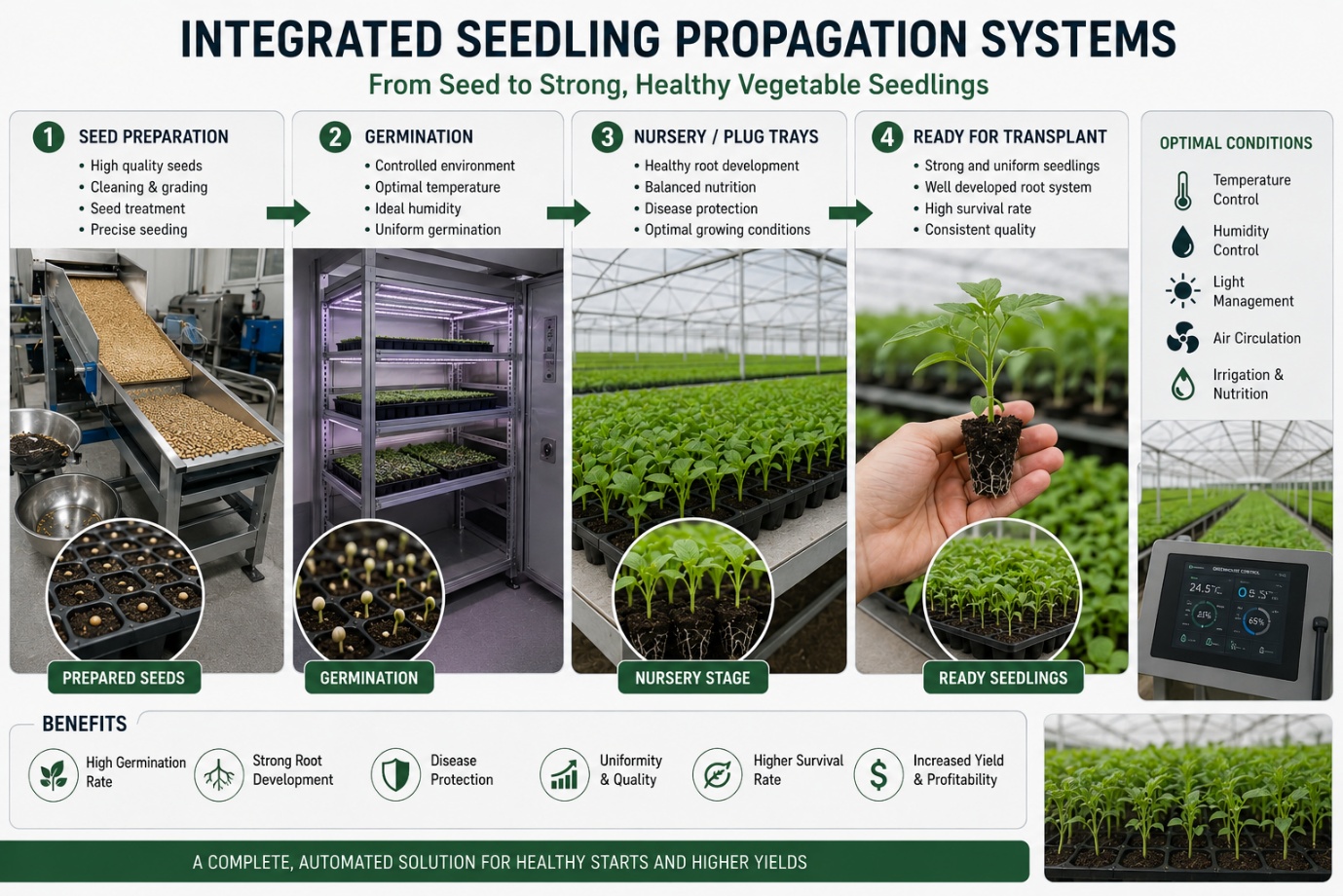
Professional greenhouse nurseries operate through a structured propagation sequence designed to ensure uniform plant development and reliable crop establishment:
Seed Selection → Precision Seeding → Controlled Germination → Nursery Growth → Transplanting to Production Greenhouse
Each stage in this propagation process plays a critical role in ensuring that seedlings reach the production greenhouse in optimal condition.
Seed Selection
High-quality hybrid seeds are selected according to the production program, crop variety, and greenhouse growing strategy. Modern greenhouse vegetable production increasingly relies on genetically improved hybrid varieties that provide high yield potential, disease resistance, and consistent fruit quality.
Because these seeds are often expensive, careful handling and precise propagation management are essential to maximize germination success and maintain seedling quality.
Precision Seeding
Seeds are placed accurately into seedling trays using professional precision seeding machines. These machines ensure that each tray cell receives a single seed at the correct depth and spacing. Precision seeding provides several advantages:
- Accurate seed placement
- Uniform sowing depth
- Prevention of seed waste
- Improved germination consistency
- Higher operational efficiency in the nursery
This step is particularly important when working with high-value hybrid seeds.
Controlled Germination
After sowing, seed trays are transferred to a controlled germination room where environmental conditions are carefully regulated. During this early phase, seeds require stable temperature and humidity levels to germinate properly. Germination rooms provide a controlled environment that promotes rapid and uniform seed emergence. Typical conditions include:
- Stable temperature optimized for the crop
- Controlled humidity levels
- Darkness during early germination
- Uniform environmental conditions for synchronized emergence
Once the seeds germinate, trays are moved to the nursery growing area.
Nursery Growth Stage
Following germination, seedlings continue their development in the nursery growing area. During this stage, young plants establish their root systems and begin vegetative growth. Professional nursery management focuses on maintaining:
- Uniform irrigation
- Balanced nutrient supply
- Proper ventilation
- Stable environmental conditions
These factors support strong root development and healthy plant structure.
Seedling Development Period Before Transplanting
In commercial greenhouse vegetable production, seedlings remain in the nursery for a defined period before being transplanted into the production greenhouse. This stage allows plants to develop strong root systems and stable vegetative structures that support healthy growth during the full production cycle.
For many greenhouse vegetable crops, the nursery stage typically lasts between 18 and 35 days, depending on crop type and environmental conditions. Typical nursery periods include:
- Tomatoes — approximately 25–30 days
- Sweet peppers — approximately 30–35 days
- Cucumbers — approximately 18–22 days
- Lettuce — approximately 18–25 days
Maintaining optimal nursery conditions during this period ensures that seedlings enter the production greenhouse with uniform size, strong stems, and healthy root systems.
Irrigation and Early Nutrient Management
Seedlings require carefully managed irrigation and nutrition during the early stages of development. Excess irrigation may weaken root development, while insufficient water can stress young plants. Professional nursery irrigation systems therefore provide precise and uniform watering adapted to the delicate requirements of young seedlings.
Balanced nutrient solutions are gradually introduced to support healthy root formation and strong plant structure. Proper nutrient management during this stage promotes:
- Strong stem development
- Healthy root systems
- Balanced vegetative growth
- Improved plant resilience after transplanting
Pest Protection and Nursery Climate Management
Young seedlings are particularly sensitive to pests and environmental stress. For this reason, professional nurseries are typically constructed as protected structures equipped with insect-proof screening systems. These protective screens prevent the entry of harmful insects that could transmit plant viruses or damage young plants.
Proper ventilation systems are also essential to maintain stable nursery conditions by regulating temperature, humidity, and air circulation. Stable environmental conditions support healthy seedling development while reducing the risk of fungal diseases.
Integration with Greenhouse Production
In greenhouse projects developed by Orgil Profiline Greenhouses Int, the nursery is designed as an integral part of the overall production infrastructure. The nursery structure is engineered to provide optimal growing conditions during the early stages of plant development while maintaining high levels of hygiene and pest protection.
Professional nursery systems within greenhouse projects typically include:
- Precision seeding machines
- Controlled germination rooms
- Insect-proof nursery structures
- Optimized irrigation and nutrient delivery systems
- Specialized nursery transport trolleys for safe movement of seedlings to the production greenhouses
By integrating nursery propagation systems with greenhouse production infrastructure, growers can ensure higher seedling quality, improved plant uniformity, reduced disease risks, and better utilization of high-value hybrid seeds.