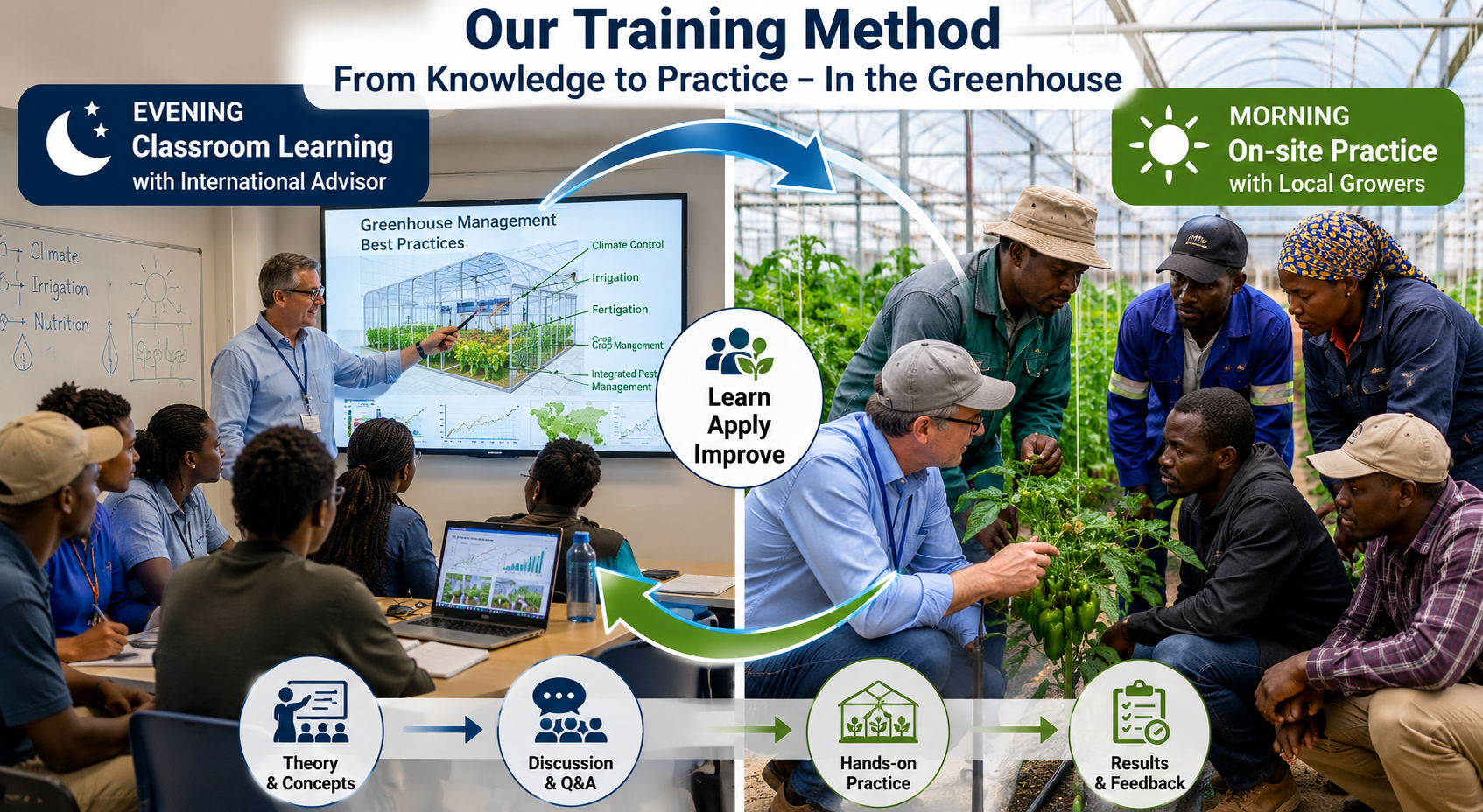
ORGIL's philosophy extends far beyond the supply of greenhouse infrastructure and advanced agricultural technologies. The company's objective is to establish a sustainable agricultural ecosystem by developing local human capital, transferring practical knowledge, and creating a new generation of professional agronomists, growers, greenhouse managers, and agricultural leaders.
For large-scale agricultural projects, ORGIL implements a structured Learn, Train & Transfer (LTT) methodology that combines academic education, hands-on field experience, and continuous mentoring by international experts.
Strategic Partnerships with Universities and Agricultural Colleges
For large-scale projects, ORGIL promotes the establishment of formal partnerships with local universities and agricultural institutions. Under this framework:
- Final-year agriculture students participate in the project as part of their internship, practical training program, or graduation project requirements
- Students gain direct exposure to advanced greenhouse technologies and modern Controlled Environment Agriculture (CEA) systems
- The project serves as a living agricultural laboratory where academic knowledge is transformed into practical commercial production experience
- Universities benefit from providing their students with real-world training opportunities, while the project gains access to a continuous pipeline of motivated and educated future professionals
This approach creates a strong connection between academia and commercial agriculture and significantly accelerates the development of local agricultural expertise.
Young Agronomist Development Program
Each agronomist participating in the program is assigned direct responsibility for a specific greenhouse production unit. Depending on the size and complexity of the project, one agronomist may be assigned responsibility for a single greenhouse compartment or production block. In larger projects, an agronomist may oversee two or more greenhouse units, supported by technicians and production supervisors.
Each agronomist is responsible for:
- Monitoring crop development and performance
- Implementing irrigation and fertigation programs
- Conducting pest and disease scouting activities
- Supervising daily labor operations within the assigned greenhouse area
- Recording and reporting production data and observations
- Implementing technical recommendations provided by the expert team
This structure promotes accountability while allowing young professionals to gain practical management experience from the beginning of their careers.
Daily Learning & Operational Planning Center
One of the key components of the ORGIL methodology is the establishment of a centralized Learning and Operational Planning Center within the project. At the end of each working day:
- Agronomists, greenhouse supervisors, and key technical personnel gather for a structured review session
- Crop performance, climate data, irrigation activities, fertigation performance, labor productivity, and operational challenges are analyzed
- ORGIL specialists present the operational plan and technical objectives for the following day
- Detailed explanations are provided regarding the agronomic rationale behind each planned activity
- Participants discuss challenges, observations, and opportunities for improvement
The following day, the agronomists return to their assigned greenhouse units and work directly with farmers, technicians, and greenhouse personnel to ensure that all activities are implemented according to the highest professional standards.
Field Coaching & Continuous Expert Supervision
The daily learning process is reinforced through continuous field supervision by ORGIL experts. Throughout the production season, ORGIL specialists conduct regular inspections and coaching visits across all greenhouse units. During these visits, experts:
- Evaluate crop performance and plant health
- Verify compliance with irrigation and fertigation programs
- Review implementation of daily operational plans
- Identify operational mistakes and inefficiencies
- Provide immediate corrective guidance
- Conduct hands-on field demonstrations and practical training
- Share best practices and lessons learned from similar projects worldwide
This continuous interaction creates a dynamic learning environment where theory and practice are seamlessly integrated.
Creating a Culture of Continuous Improvement
The ORGIL methodology is based on a simple but highly effective daily cycle:
This cycle is repeated throughout every production season, enabling rapid knowledge acquisition and continuous professional development.
Developing Local Agricultural Leadership
The objective is not only to operate a successful greenhouse project but also to develop a new generation of agricultural professionals capable of leading the sector in their own country. After completing a full production season, participating agronomists typically acquire:
- Practical experience that cannot be gained through academic studies alone
- A comprehensive understanding of commercial greenhouse management
- The ability to make independent technical and operational decisions
- Strong leadership and workforce management skills
- A solid foundation for continued professional growth and specialization
Long-Term Vision
ORGIL believes that the greatest legacy of a successful agricultural project is not the greenhouse infrastructure itself, but the people who acquire the knowledge and skills required to operate and continuously improve it.
By the completion of the Learn, Train & Transfer process, the project is no longer dependent on foreign expertise but is operated by highly trained local professionals who have developed their capabilities within the project itself. Each project becomes a center of agricultural excellence that strengthens local institutions, creates high-quality employment opportunities, and contributes to the long-term development of the national agricultural sector.