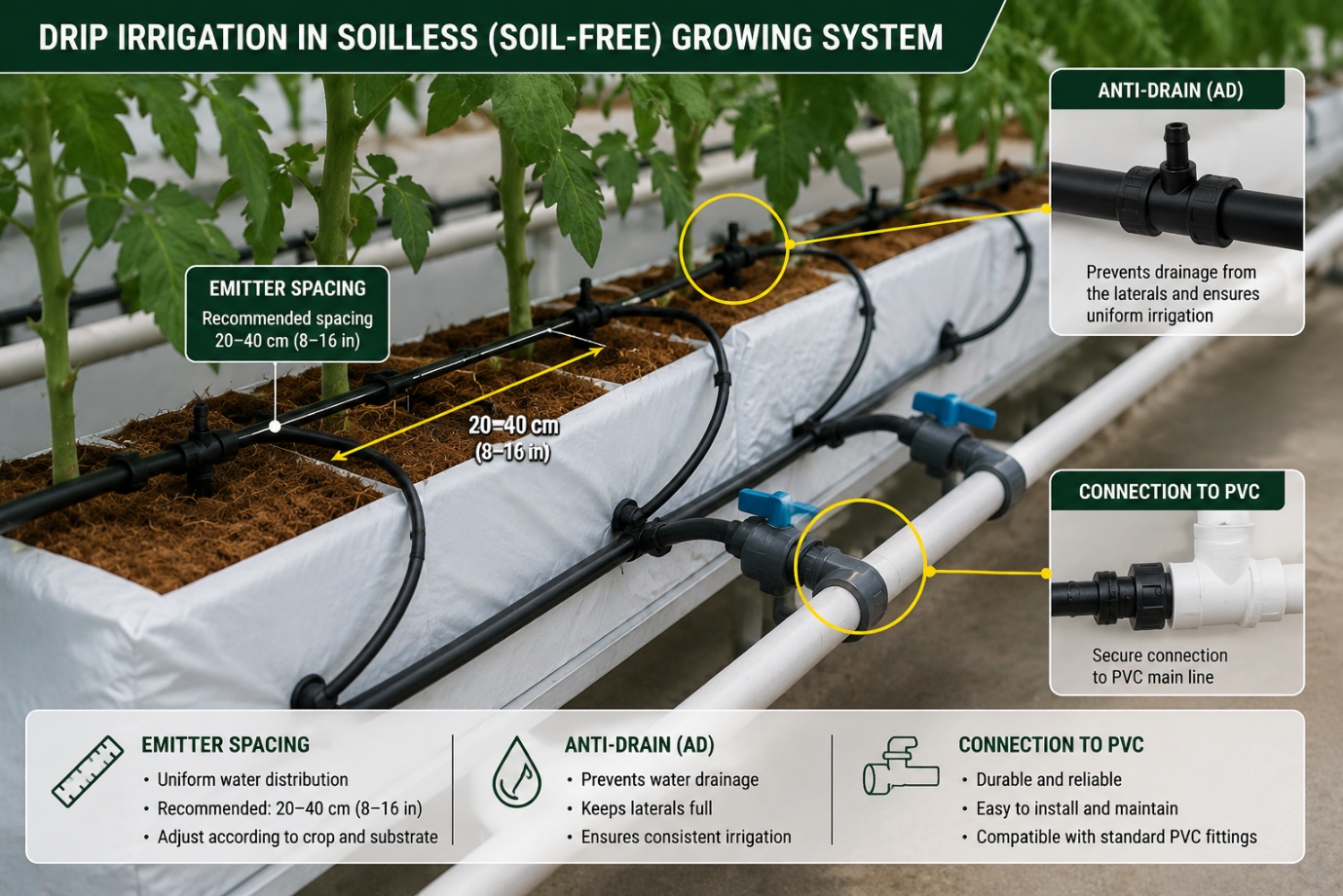
In modern greenhouse agriculture, efficient water and nutrient management is not only a matter of irrigation technology — it is a key factor determining crop productivity, resource efficiency, and the long-term sustainability of greenhouse operations.
As global agriculture faces increasing pressure on water resources, efficient irrigation and responsible water use are essential for both economic performance and environmental sustainability. In controlled-climate greenhouses, irrigation is no longer based solely on theoretical evapotranspiration calculations. Modern greenhouse production increasingly relies on precision irrigation and fertigation technologies that allow growers to deliver exactly the amount of water and nutrients required by the plants at each stage of development.
Precision Drip Irrigation Systems
Modern greenhouse irrigation systems are based on precision drip irrigation, which delivers water and dissolved nutrients directly to the plant root zone. A typical greenhouse irrigation network includes a central water reservoir, a fertigation control unit, main pipelines, secondary distribution lines, and drip irrigation lines running along each crop row.
These drip lines are equipped with pressure-compensated emitters that ensure uniform water and nutrient distribution across the entire greenhouse, allowing each plant to receive the same irrigation dose regardless of its position along the line.
Anti-Leak Drip Emitters
In advanced greenhouse systems, drip lines incorporate Anti-Leak drip emitters, which prevent irrigation lines from draining between irrigation cycles. When system pressure drops, the emitter closes automatically, keeping the irrigation lines filled. Key advantages include:
- Irrigation begins immediately with uniform pressure along the entire line
- Improved uniformity of irrigation pulses
- Prevention of water drainage from irrigation lines between cycles
- Reduced fertilizer loss from irrigation lines
- Improved efficiency of pulse irrigation strategies
Fertigation Systems & Nutrient Management
In modern greenhouses, irrigation and fertilization are closely integrated through fertigation systems, which deliver water and dissolved nutrients simultaneously through the drip irrigation network. Fertigation systems typically include several fertilizer tanks containing different nutrient components, allowing precise preparation of nutrient solutions tailored to the specific requirements of the crop.
Common nutrient components include nitrogen, potassium, phosphorus, calcium, magnesium, and micronutrient mixtures containing trace elements such as iron, manganese, zinc, copper, and boron. Nutrient formulations are adjusted according to crop species, plant age, growth stage, and greenhouse climate conditions:
- Vegetative stage: higher nitrogen availability supports leaf and stem development
- Flowering stage: balanced nutrient supply supports flower formation
- Fruit development stage: increased potassium supports fruit growth, quality, and shelf life
Electrical conductivity (EC) and pH sensors continuously monitor nutrient solution conditions to ensure that plants receive optimal nutrient concentrations throughout the production cycle.
Pulse Irrigation
One of the most effective techniques used in modern greenhouse irrigation is pulse irrigation. Instead of applying large irrigation volumes at longer intervals, irrigation is delivered in multiple short pulses throughout the day. Each pulse provides a small and controlled amount of water that plants can absorb efficiently.
- Improved water distribution in the root zone
- Stable moisture conditions around the roots
- Improved oxygen availability in the root zone
- Reduced plant stress between irrigation events
- Improved nutrient uptake efficiency
When combined with Anti-Leak emitters, pulse irrigation becomes particularly efficient, as irrigation lines remain filled and each irrigation pulse begins immediately with uniform pressure.
Drainage Collection & Water Recycling
An important component of advanced greenhouse irrigation systems is the collection and reuse of drainage water. Instead of allowing this water to be lost or infiltrate the soil, modern greenhouse systems collect the drainage water and reuse it after proper treatment.
- Reduced overall water consumption
- Recovery of valuable nutrients remaining in drainage water
- Lower fertilizer costs over the production cycle
- Prevention of nutrient leaching into groundwater
- Improved environmental sustainability and regulatory compliance
Collected drainage water typically undergoes treatment through filtration systems, UV disinfection, and additional sanitation technologies before being returned to the irrigation cycle, allowing greenhouse irrigation systems to operate as closed-loop systems where water and nutrients remain within the production cycle.
Plant-Demand Based Irrigation
Traditional irrigation strategies often rely on theoretical evapotranspiration calculations to estimate crop water demand. However, such calculations may not always reflect the actual water needs of plants under greenhouse conditions. Modern greenhouse irrigation systems increasingly rely on plant-driven irrigation strategies, where irrigation decisions are based on plant activity and root-zone conditions.
By combining pulse irrigation, drainage monitoring, and environmental sensor data, growers can supply plants with exactly the amount of water required at any given moment, rather than relying solely on theoretical evaporation models.
Sensor-Based Irrigation Control
Advanced greenhouse irrigation systems integrate multiple sensors that continuously monitor environmental and root-zone conditions, providing real-time data used to determine when irrigation pulses should begin and how much water should be applied:
- Solar radiation sensors, measuring plant activity and transpiration potential
- Drainage monitoring systems, measuring drainage volume and EC levels
- EC and pH sensors, monitoring nutrient solution concentration and acidity
These measurements allow irrigation systems to respond dynamically to plant demand and changing greenhouse conditions.
Intelligent Irrigation Algorithms
Modern greenhouse control systems combine sensor data with advanced irrigation algorithms that analyze plant and environmental conditions. Irrigation decisions may be based on accumulated solar radiation, time since the previous irrigation pulse, drainage percentage and drainage EC, greenhouse temperature and humidity, and root-zone nutrient levels. Using this information, the system determines the optimal timing and volume of the next irrigation pulse — closely following the physiological needs of the crop.
Smart Water Recycling — NUF Membrane Technology
The advanced water recycling system implemented by Orgil Profiline Greenhouses is based on the controlled collection of irrigation runoff, integrated with NUF membrane filtration technology, enabling efficient water treatment and sanitization without the use of chemicals and in line with high environmental standards.
Using a high-precision membrane (≈30 nanometers), the system removes pathogens, suspended solids, organic matter, and most viruses, producing high-quality water suitable for reuse in intensive agriculture.
As a closed-loop system, it prevents the discharge of nutrient-rich irrigation effluents, significantly reducing the risk of groundwater and aquifer contamination while supporting compliance with environmental requirements.
By enabling the reuse of both water and nutrients, the system improves resource efficiency, reduces environmental impact, and supports sustainable agricultural production — fully integrated into the greenhouse solutions designed and implemented by Orgil Profiline Greenhouses.